
Like a Hummingbird
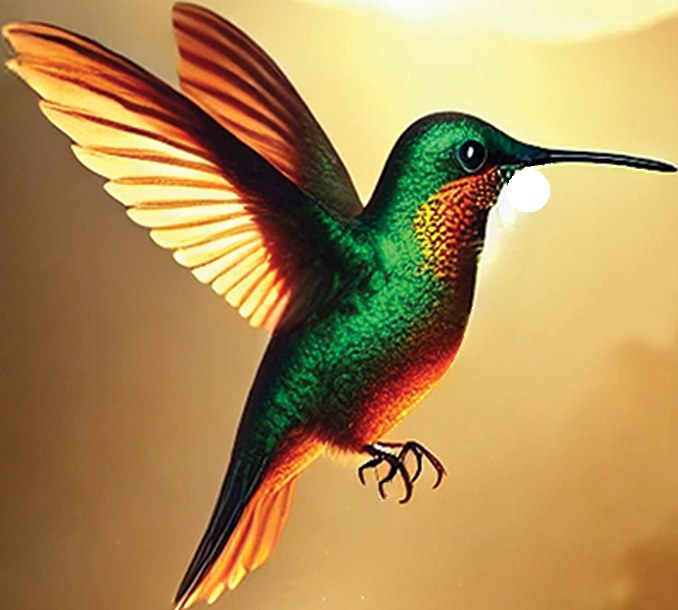
You might have noticed that the hummingbird shows up again and again in my books. Hummingbirds have always fascinated me. Not just for their beauty. They seem to carry a deeper message.
In our back yard, we have bird feeders that we fill for them. We have three of them. They get low, and sometimes we change three in a day, or four in a day, even. They're for hummingbirds, and they eat sugar and water.
We feed about 30 to 40 hummingbirds each day. And some days we go through close to a kilo of sugar. It's insane.
I watch them hover, sip, and then zoom away. They're so fast. And at the same time, when they're there, they're completely there.
They're amazing little birds. They're the only birds that can fly backwards. When they hover, their wings can beat anywhere from 720 to 5,400 times a minute, depending on the kind of hummingbird. That's where the name comes from, the humming sound their wings make.
Their little hearts are something else too. When a hummingbird is resting, its heart beats about 225 times a minute. When it's flying, it can go over 1,200. And they're fast. They've been clocked at close to 30 miles an hour. When a male dives to show off for a female, he can go more than 45.
Most hummingbirds weigh less than a nickel. The smallest one, the bee hummingbird, lives in Cuba and is only about two inches long. And those beautiful shining colors on their feathers come from tiny structures that work like prisms. They break the light up into all its colors.
The mother builds the nest by herself. It's a little cup about the size of a walnut shell, woven from spider webs and bits of plants. She lays one or two eggs, each one about as small as a pea.
They only live in the Americas. There are more than 330 kinds of them, and most of them live south of the United States. Some of them fly 500 miles across the Gulf of Mexico every spring, for about 20 hours without stopping. A bird that weighs less than a nickel.
You can find them all the way from the tip of South America up to southern Alaska. Some live high in the Andes mountains, as high as 16,000 feet.
And they rest a lot. All that flying takes so much energy that they spend most of their time sitting quietly on a branch. At night they go into a deep rest called torpor, where everything slows way down. Then in the morning they're back at the feeders.
They love red and orange flowers, especially the long ones shaped like a tube that hang down. The nectar in those flowers is about 26 percent sugar. That's about double what's in a soft drink. They draw it up with a long tongue, the same way water climbs up a straw.
They eat more than sugar, too. They catch tiny flying insects right out of the air, and they feed them to their babies.
They remind me of how we can be both fast moving and deeply present. And how we keep returning to the source for nourishment, the same way we keep coming back to the truth inside us.
There's another hummingbird I've always been drawn to. It's in the desert in Peru, among the Nazca Lines. These are huge figures drawn on the ground a very long time ago. The hummingbird is about 300 feet long, and you can really only see the whole shape from the air.
Who made them, and why? People have all kinds of ideas about that. Nobody really knows. I like to leave it as a mystery. But I find it interesting that of all the things they could have drawn there, one of them is a hummingbird.
The hummingbird hovers and finds what it needs in the smallest flowers. We can find answers in the small, quiet things in life too, if we're willing to be still and look closer.
Something to try
In the middle of a busy day, stop for a moment, like a hummingbird at a flower. Be still. Take one slow breath, and be completely where you are. Then zoom off again.
It's a way to be fast moving and present at the same time. You can try it right now, or the next time your day gets busy.
Some of you have already started on this path, and for some of you it's brand new. Either way is okay. Just try it and see.
If you want to know more, come check out my free Truth Whispering class. I teach it once a month, and you're welcome to come. And I write about the hummingbirds in my third book, Truth Whispering Part III: Living the Truth.